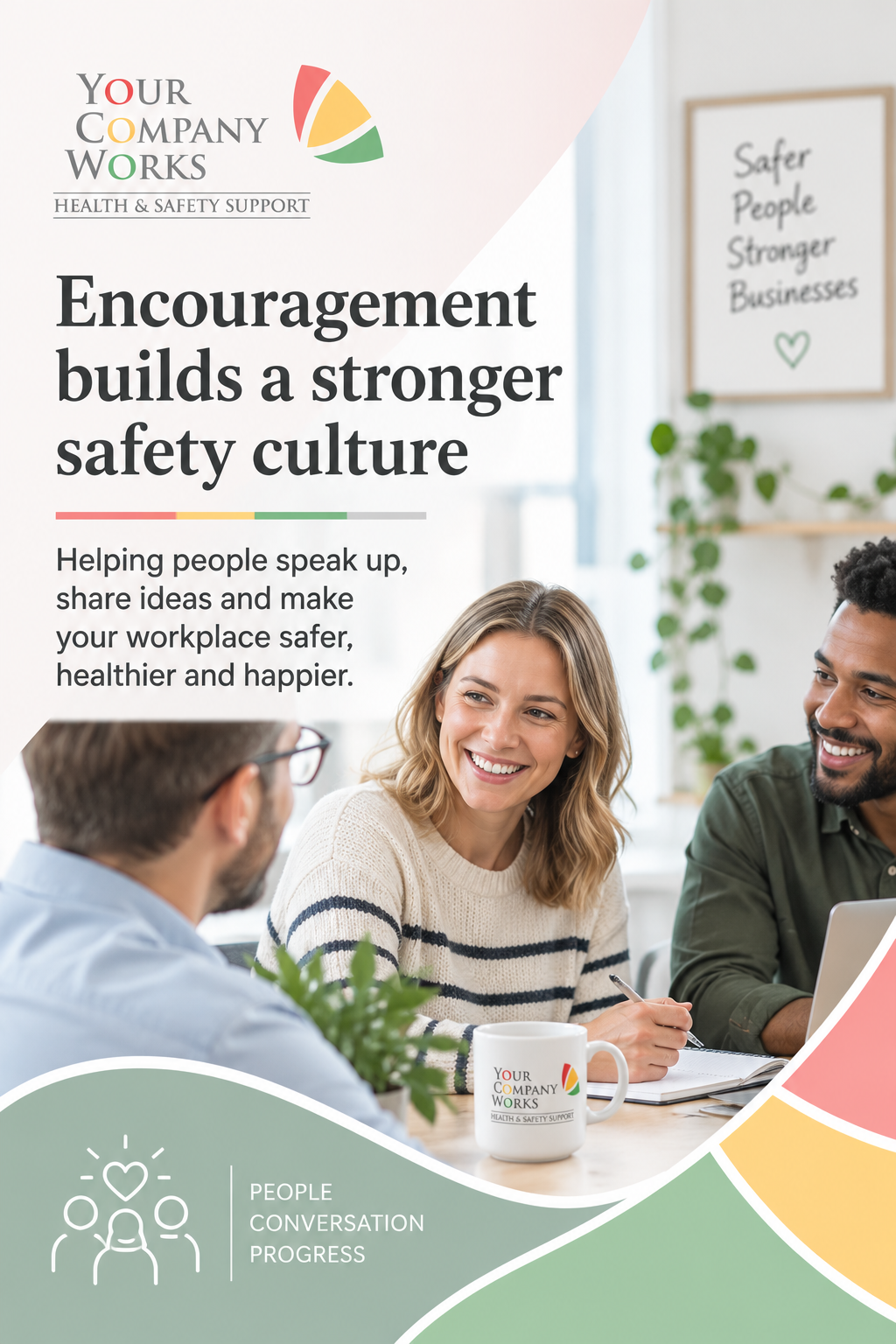
A positive workplace safety culture starts with people feeling able to speak up, share concerns and know they will be listened to.
This week, we’re taking inspiration from National Day of Encouragement on 12 September and looking at something that can make a very real difference to workplace health and safety: encouraging people to speak up, get involved and help make things better.
A positive safety culture isn't created by a policy sitting in a folder.
It is created by what happens every day.
How to Build a Positive Workplace Safety Culture
Can an employee say that something doesn't feel safe? Can they report a near miss without worrying about being blamed? Are managers willing to listen? When somebody raises a concern, does anything happen afterwards?
These everyday behaviours can tell you a great deal about the health and safety culture within a business.
Why Encouragement Matters in a Positive Workplace Safety Culture
Employees often have a very different view of workplace risks from managers because they are the people on the ground, doing the work.
They may notice the awkward process that has become normal, the piece of equipment that regularly causes a problem, the workload pressure affecting the team or the near miss that could easily have become an accident.
Businesses therefore need ways for people to raise these things.
That could include regular team conversations, a clear reporting process, employee consultation, one-to-one discussions or simply creating an environment where people know their concerns will be taken seriously.
Encouragement doesn't mean telling people that everything is fine.
Sometimes it means saying:
“Tell me what isn't working.”
And then being prepared to listen.
Make reporting useful, not frightening
In a positive workplace safety culture, reporting a near miss should be seen as an opportunity to learn and improve, rather than something to blame someone for.
If someone nearly slips, equipment almost fails or a process goes wrong without anybody being injured, the fact that nobody was hurt doesn't necessarily mean there is nothing to do.
A useful reporting procedure helps capture what happened, understand why it happened and decide whether something needs to change.
The focus should be on learning and preventing recurrence.
If people believe every report will result in blame, criticism or unnecessary fuss, they may be less willing to tell you what is happening.
A business cannot manage a risk it doesn't know about.
Consultation is part of good health and safety
Employee consultation plays an important role in building a positive workplace safety culture. The people doing the work often have valuable insight into what is working, what isn't and where improvements could be made.
Consultation shouldn't only happen after something has gone wrong.
Talking to employees about the work they do, the risks they experience and how those risks are controlled can help businesses identify practical solutions that actually work.
It can also make introducing new policies, procedures or controls much easier because the people affected have had an opportunity to contribute.
Good consultation is two-way.
Ask.
Listen.
Consider what you've been told.
Then let people know what is happening as a result.
Consult your employees on health and safety to the HSE guidance on consulting and involving workers.
Your policies should support the culture you want
Health and safety policies and procedures provide the framework, but they need to reflect what actually happens within the business.
For example:
- Is there a clear way to report an accident, incident or near miss?
- Do employees know who to speak to about a concern?
- Are responsibilities clear?
- Are risk assessments being reviewed when things change?
- Does somebody check that agreed actions have actually happened?
- Are employees consulted when changes could affect their health and safety?
Simple, workable arrangements are usually far more valuable than complicated documents nobody uses.
Encouragement matters to health as well as safety
Positive workplace culture isn't only about preventing accidents.
It matters when managing health and wellbeing too.
Work-related stress can be associated with areas including workload, control, support, relationships, role and organisational change.
Employees need to know they can raise concerns before those concerns become bigger problems.
Managers don't need to have every answer themselves. What matters is having suitable arrangements for recognising concerns, listening and deciding what appropriate action or support may be needed.
Competent advice can give managers confidence too
Competent Health & Safety advice can also help business owners create a positive workplace safety culture by turning good intentions into practical, workable arrangements.
Employees aren't the only people who sometimes need encouragement.
Health and safety responsibility often sits with busy business owners or managers who are already managing a very long list of responsibilities.
UK employers must appoint someone competent to help them meet their health and safety duties. Depending on the business, that could be the employer themselves, somebody within the organisation, an external adviser or a combination.
Good competent support shouldn't simply hand a business another folder of documents.
It should help you understand what matters, decide what needs doing and put arrangements in place that work for your organisation.
Positive safety culture needs both people and process
Encouraging people to speak up is important.
But encouragement works best when there is a practical system behind it.
That can include:
Competent Person advice
Someone who can help you understand your responsibilities and identify sensible priorities.
Policies and procedures
Clear arrangements that people can understand and follow.
Employee consultation
Giving the people doing the work an opportunity to contribute.
Reporting procedures
Making it easy to raise concerns, incidents and near misses.
Near-miss and incident reviews
Looking at what happened, understanding why and learning from it.
Risk assessments
Identifying hazards and putting sensible controls in place.
Stress management
Recognising that protecting health includes psychological as well as physical health.
The aim isn't to create a workplace where nobody ever makes a mistake or raises a concern.
Quite the opposite.
A strong safety culture is one where people feel able to say something, managers are prepared to listen and the business is willing to learn.
Need a guiding hand?
If you're responsible for health and safety but aren't sure whether your current arrangements are working as well as they could, Your Company Works can help.
If you'd like to strengthen your positive workplace safety culture, we provide calm, friendly and practical Health & Safety support tailored to the needs of your business, from competent advice and risk assessments to policies, consultation, reporting arrangements, incident reviews and stress management.
Let's make health and safety something your people can participate in, not something that simply happens around them.
Get in touch with Your Company Works for a friendly conversation about what would work for your business.