Inclusion and health and safety often overlap more than you might think
Running a business means juggling a lot of moving parts.
There are clients to look after, deadlines to meet, people to manage, problems to solve and plans to keep moving forward. Somewhere within all of that sits another important responsibility: making sure the people working in your business can do their jobs safely and comfortably.
That is where inclusion and health and safety often meet.
A workplace may have good policies, risk assessments and procedures in place, but people are different. Their circumstances, health, experience and needs can change how well those arrangements work for them.
Last week, we talked about creating a positive health and safety culture. An important part of that culture is making sure people feel able to say when something is not working for them.
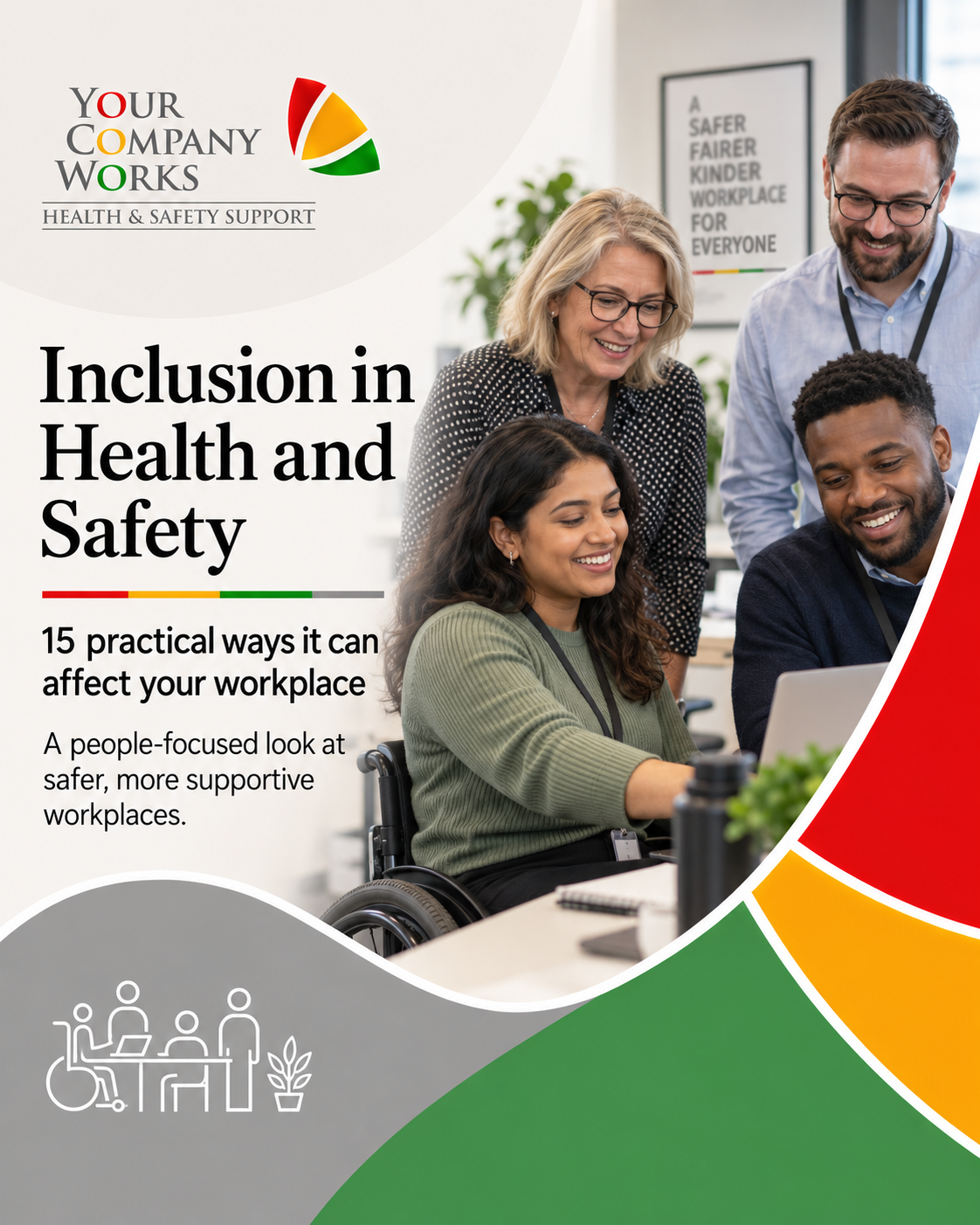
This National Inclusion Week, we are looking at 15 everyday situations where inclusion may need to be considered as part of workplace health and safety.
The aim is not to make things more complicated.
Quite the opposite.
It is about noticing when a standard approach may need a small adjustment.
1. Disability or a long-term health condition
A disability or long-term health condition does not automatically mean someone cannot carry out their job safely.
It may simply mean that a task, workstation, environment or procedure needs to be looked at slightly differently.
Health and safety areas to consider:
Individual risk assessments, workplace adjustments, working arrangements, equipment and procedures.
2. Mobility difficulties
Mobility can affect much more than getting into and around a building.
Think about access to work areas, stairs, doors, toilets, workstation layouts and, importantly, what would happen during an emergency.
Health and safety areas to consider:
Access and layout, emergency evacuation arrangements, PEEPs and workplace risk assessments.
3. Hearing impairment
Would every employee know if an alarm sounded?
Would they receive important instructions during an emergency?
Even very good procedures can fail if the way information is communicated does not work for the person receiving it.
Health and safety areas to consider:
Alarm systems, emergency communication, training and evacuation arrangements.
4. Visual impairment
Lighting, signage, walkways, information and screen-based work can all affect how safely somebody navigates and works within a workplace.
Sometimes relatively straightforward changes can make a significant difference.
Health and safety areas to consider:
Lighting, signage, safe routes, accessible information, display screen equipment and emergency procedures.
5. Neurodivergence
People can process information, sensory input and communication differently.
Noise, lighting, interruptions, unclear instructions or frequent changes may affect one person very differently from another.
It is not about creating a completely different workplace. It is about understanding whether something within the existing environment is creating an unnecessary barrier.
Health and safety areas to consider:
Working environment, communication, display screen equipment, workplace adjustments, procedures and stress management.
6. Mental health and work-related stress
Health and safety is not only about physical injury.
Workload, relationships, change, unclear responsibilities and lack of support can all contribute to workplace pressure.
Managers do not need to become mental health experts, but they should be able to recognise when something may need attention.
Health and safety areas to consider:
Stress risk management, workloads, role clarity, workplace support and individual reviews.
7. Pregnancy
Pregnancy can change how somebody experiences tasks and working conditions that they previously managed without difficulty.
As pregnancy progresses, those needs may change again.
This is why maternity risk assessments should reflect the individual and their actual work.
Health and safety areas to consider:
Maternity risk assessments, manual handling, fatigue, working conditions, workstations and exposure to workplace hazards.
8. New mothers and breastfeeding employees
Returning to work after having a baby can bring another set of practical considerations.
Working arrangements, facilities, physical comfort and existing risks may need reviewing again rather than assuming the arrangements that worked before pregnancy are still appropriate.
Health and safety areas to consider:
Maternity risk assessment reviews, workplace facilities, working arrangements and workplace adjustments.
9. Menopause or other changing health needs
People's health does not remain exactly the same throughout their working lives.
Changes in temperature tolerance, fatigue, sleep, concentration or comfort can affect someone's experience at work.
The important thing is creating an environment where concerns can be discussed and practical solutions considered.
Health and safety areas to consider:
Workplace temperature, workstations, stress, working arrangements and individual adjustments.
10. Temporary injury or recovery from illness
Sometimes the need for an adjustment is temporary.
An employee recovering from an operation, injury or illness may still be perfectly capable of working, but one part of their normal job may temporarily be difficult.
Health and safety areas to consider:
Temporary risk controls, task reviews, workstation adjustments and return-to-work arrangements.
11. Returning after a long-term absence
A lot can change while somebody is away from the workplace.
Their health may have changed. Their role may have changed. The workplace itself may have changed.
A short review before or during their return can help identify practical issues early.
Health and safety areas to consider:
Risk assessment reviews, duties, display screen equipment, training, workplace changes and phased return arrangements.
12. Young workers or work-experience students
Experience matters.
Someone new to the world of work may not recognise hazards or understand why certain procedures are important in the same way as a more experienced employee.
They may also be less confident about speaking up when they are unsure.
Health and safety areas to consider:
Risk assessments, supervision, training, induction and competency.
13. New starters
Every workplace has things that everybody simply "knows".
Except the new person.
New starters do not yet have that background knowledge, which is why clear induction and communication are so important.
Do they know what to do in an emergency? Who to ask? How to report a problem? Which procedures apply to them?
Health and safety areas to consider:
Induction, training, competency, emergency procedures and safe systems of work.
14. Language, literacy or communication differences
Providing information is only useful if the person receiving it can understand and use it.
Sometimes clearer wording, visual information, demonstrations or simply checking understanding can make safety information much more effective.
Health and safety areas to consider:
Training, instructions, procedures, signage and communication methods.
15. Hybrid, home or lone working
Not everyone works from the same desk, in the same building, every day.
Hybrid and home working can introduce different considerations around workstations, communication and wellbeing.
Lone working can also mean thinking differently about how someone gets help if something goes wrong.
Health and safety areas to consider:
Display screen equipment assessments, lone-working risk assessments, communication arrangements, stress and welfare.
Inclusion does not have to mean another complicated system
This is perhaps the most important point.
You do not necessarily need another policy, another enormous form or another layer of administration.
Often, good inclusive health and safety starts with a much simpler question:
Does the arrangement we already have actually work for this person?
If the answer is no, the next step is to understand why and decide whether something reasonable and practical needs to change.
That could mean reviewing a risk assessment.
It could mean changing a workstation.
It could mean looking at emergency arrangements.
Or it could simply mean having a conversation with the person doing the job.
Good health and safety should support people to work safely, not make running the business unnecessarily difficult.
How Your Company Works can support a more inclusive workplace
Your Company Works provides calm, professional and friendly health and safety support for busy business people.
Depending on what your business needs, we can help with areas including:
Risk assessments • Individual risk assessment reviews • Display screen equipment assessments • Maternity risk assessments • Fire risk assessments • PEEPs and emergency planning • Health and safety policies and procedures • Stress management • Workplace adjustments • Training and competency • Competent Person support
The aim is always the same: practical, proportionate solutions that work for your people and your business.
Free Health and Safety Wheel of Inclusion
We have also created a Your Company Works Health and Safety Wheel of Inclusion highlighting these 15 areas and the health and safety considerations that may sit alongside them.
It is designed as a simple reference tool for business owners, office managers and operational managers.
Would you like a free copy for your workplace? or would a chat about your health and safety be more helpful?
Please get in contact
Email paula@yourcompanyworks.com
Phone 07799 533094